Maritime Preservation


About the Maritime Preservation Program
The Wisconsin Historical Society's Maritime Preservation and Archaeology Program is dedicated to preserving Wisconsin's historic shipwrecks and other underwater non-renewable cultural resources.
From its inception in 1988, the cornerstones of the program have been:
- Systematic field investigation and documentation activities
- Background research on written documents, images, and in-person interviews
- The use of cutting-edge technology
- Pro-active public outreach and education programs designed for audiences of all ages
Underwater view of the port anchor on the schooner Home. The anchor and chain are resting against the port side of the ship near the bow, partially submerged in the lake bed. ID:W01360T
Program History
The Maritime Preservation and Archaeology initiative at the Wisconsin Historical Society was created in January of 1988 in response to the passage of the U. S. Abandoned Shipwreck Act of 1987. This act gave the state the responsibility to manage abandoned historic shipwrecks in state waters. The Program became an active research unit of the State Archaeology Program.

Wisconsin's Great Lakes Shipwrecks
The Maritime Trails initiative encourages divers, snorkelers, boaters, maritime enthusiasts, and tourists to visit and enjoy Wisconsin's diverse collection of maritime resources. A collaborative effort between the Wisconsin Historical Society and the UW-Madison Sea Grant Institute, the Maritime Trails initiative seeks to document, preserve, and protect the state's submerged archaeological sites in Lakes Superior & Michigan.
Explore Shipwrecks
Lake Mendota Canoes
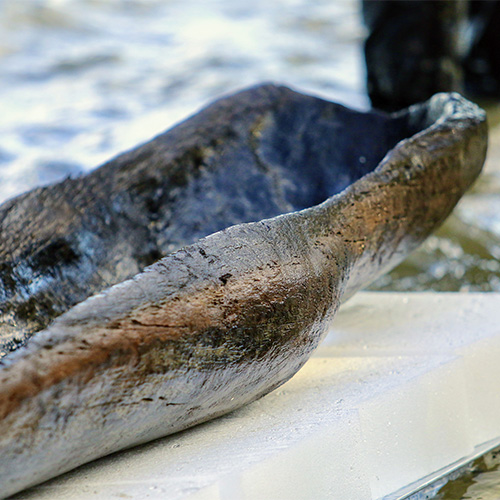
Over a span of thousands of years, 16 or more dugout canoes were left on the now-submerged shore of Madison's Lake Mendota, known to the Ho-Chunk as Wąąkšikhomįk. These canoes are a record of Indigenous life on the lake for thousands of years. They reaffirm the long and deep Indigenous connection to Wisconsin's waterways. The two most complete canoes were in danger of further deterioration or damage from boat traffic, so the decision was made in conversation with Tribal Historic Preservation Officers to raise and preserve them for future generations. Both canoes are currently housed at the Society's State Historic Preservation Facility where they are undergoing conservation. In the future, they will be viewable at the upcoming Wisconsin History Center where they will tell stories of Tribal partnership, long-term environmental change, fishing, and underwater archaeology.
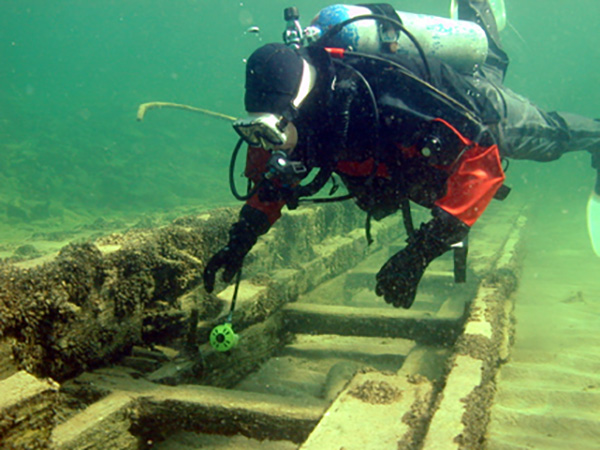
Near Gills Rock, Wisconsin. An underwater archaeologist examines the bulwarks of a sunken schooner.
Source: Maritime Archaeology, Wisconsin Historical Society
Preservation Efforts
The Maritime Preservation and Archaeology program works for the long term preservation of these shared non-renewable resources by maintaining careful field documentation. This information is made available to the public through publications, the Wisconsin's Great Lakes Shipwrecks website, and public presentations. The field documentation information is also used to list the sites on the State and National Registers of Historic Places. This adds an additional layer of protection for the sites.
As stewards of these unique historical and recreational resources, the Wisconsin Historical Society staff encourages responsible diver visitation to the fragile underwater sites. Wisconsin law prohibits unauthorized disturbance or removal of artifacts, structure, cargo, or human remains. To report damage or artifact removal from Wisconsin’s shipwrecks call 1-800-TIP-WDNR.
State Historic Preservation Office
The Society serves as Wisconsin’s federally designated State Historic Preservation Office (SHPO). The SHPO helps people connect to the past through historic places. We coordinate state and federal preservation programs that help the people of Wisconsin preserve historic places that are important to their communities. We also maintain state records for historic properties and archaeological sites.
Learn MoreContact Us Today!
You can contact the below offices by phone or by email using the links:
Archaeology: 608-264-6496
Review and Compliance: 608-261-2457
Historic Buildings: 608-264-6502
Burial Sites Preservation: 608-264-6464
National Register of Historic Places: 608-264-6502
Certified Local Governments: 608-264-6512
Report Burial Discovery Emergencies (Toll-Free in WI): 800-342-7834