Apply for a Marker


Make a Mark with Your History
Do you have a significant piece of history in your community that you would like to commemorate with a historical marker?
Anyone can apply for a Wisconsin State Historical Marker by submitting a completed application form. Individuals, public agencies, and private organizations are encouraged to nominate historic properties, persons, and events for Wisconsin State Historical Markers.
How to Apply
-
Fill Out the Pre-Application Form
Please answer the questions to the best of your ability. This will help determine your eligibility for a state historical marker and help staff to better assist you though the review process. Staff review all pre-application forms on a monthly basis. Do not submit your final application and fee until you have received approval from Society staff.
-
Download the Application Form
To apply for a historical marker, download the application. The applicant must be able to pay for the cost of the marker and the application fee of $250, agree to maintain the marker in perpetuity, and have the permission of the landowner where the marker is to be installed.
-
Make Sure Your Marker Topic and Site Location Meet Established Criteria
The Society will consider the approval of marker applications for state and local sites only if the subject meets any one of several established Historical Marker and Location Criteria. See criteria for choosing a marker topic and selecting a marker location, below.
-
Choose the Type of Marker You Want for the Site
There are three types of official Wisconsin State Historical Markers:
- Small City Marker (16" h x 24" w)
- Large City Marker (36" h x 24" w)
- Two-Post Marker (72" h x 54" w)
All are made of cast aluminum and have raised cream-colored letters on a tobacco brown background. See the Historical Markers Price List on page 4 of the application form for information on sizing, character-count limits, and pricing. Review your options and decide which will best suit your purposes and budget. You will need to indicate your choice on the application form.
For only a few hundred dollars more, you can include a photograph, map, or graphic on your Wisconsin State Historical Marker. Adding an image to your marker can greatly increase its visual interest. Including an image will reduce the total amount of text you can have on your final marker, but that trade-off might be worthwhile since, as they say, a picture is worth a thousand words.
Because limited staff capacity and a backlog of applications, please allow a minimum of four to six months for staff review and six months for production.
-
Develop Well-Documented, Clearly-Written Text to Be Included on the Marker
Thoroughly research your subject to develop a well-documented, comprehensive narrative. The amount of text needed will depend on the space available on the marker you select. Local libraries, local historical societies, and local newspapers are excellent sources for information, as are theWisconsin Historical Society's Library and Archives. For more resources to help you write your narrative, see our Tips & Tricks for Creating Your Marker, below.
-
Submit the Application and Fee
Mail the completed application and $250 application fee to:
Wisconsin Historical Society
State Historical Markers Program
816 State Street
Madison, WI 53706You will need to include the marker text and documentation.
The Society will review and approve applications that meet the requirements under Wisconsin State Statute HS 4.06. An application will be approved or disapproved within 180 days of receipt by the Society.
Ready to start your journey to apply for a Wisconsin State Historical Marker? It all starts with the Pre-Application.
Attention
The studio that produces Wisconsin's state historical markers is navigating temporary staffing shortages and supply chain issues. At this time, please allow at least seven months for delivery from the date your marker order is placed by the Wisconsin Historical Society.
Updated February 2026
Tips & Tricks for Creating Your Marker
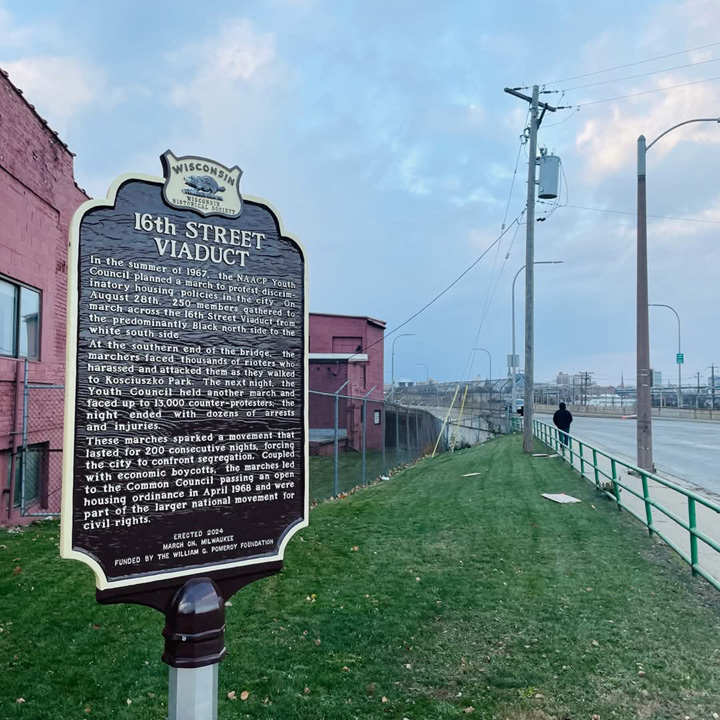
Choosing a Marker Topic
Choosing a Marker Topic
The Society will consider applications for state and local sites if the marker topic meets any of the following criteria:
Events
Associated with events that have made a significant contribution to the broad patterns of history.
People
Associated with the lives of persons no longer living who have made significant contributions to the broad patterns of history and culture.
Art and Architecture
Embodies the distinctive characteristics of a type, style, period or method of construction or architecture, or representative of the work of a master, or that possess high artistic value.
Prehistory and Archaeology
Yields, or is likely to yield, information important in prehistory or history.
Ethnic Groups
Associated with ethnic groups who have made distinctive and significant contribution to history.
State History
Embodies the characteristics of the State, representing significant aspects of the physical or natural history of the Earth and its life.
Legends
Representative of popular stories or myths that, although not verifiable, are significant to history and culture.

Selecting a Marker Location
Selecting a Marker Location
The Society has the final approval of marker location. The marker installation is the responsibility of the applicant. Markers are shipped directly from the manufacturer to the applicant.
- The site selected for the marker must be visible from a public right-of-way and be publicly accessible.
- Markers placed within a public right-of-way must get written approval from the appropriate transportation official or governing body that has jurisdiction over that public right-of-way.
- If the marker is to be placed on private property, an easement that permits public access for as long as the marker stands must be included as part of the marker application.
- The owner(s) of the site must provide written permission for the marker to be located on their property. Written permission also must allow access for ongoing maintenance of the marker.
- Only sites approved by the Society may be marked with State Historical Markers. Sites already marked with a State Historical Marker are not eligible for a second marker. No person may erect or use a marker that is identical to or misleadingly resembles the marker developed by the Society.
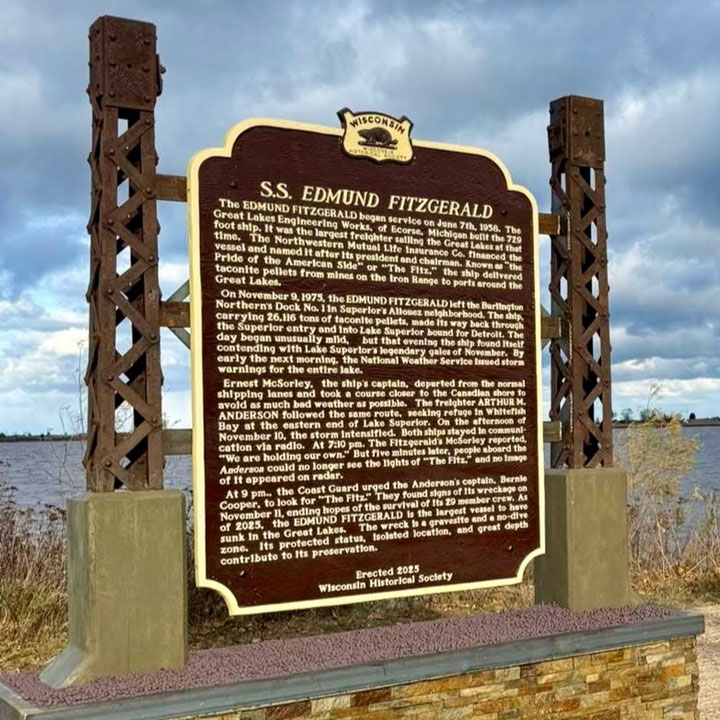
Researching Your Marker Topic
Researching Your Marker Topic
Once you choose an appropriate subject, you should begin your research. A thoroughly researched historical marker topic will result in well-documented, comprehensive text for your marker inscription. Local libraries, local historical societies, and local newspapers are excellent sources for information, as are the Library and Archives of the Wisconsin Historical Society.
Use These Questions for Your Research
-
Who was associated with the subject? Include names, birth and death dates, the chronology of important events in their lives, and their significant contributions.
-
What events occurred at this particular time or place? Of those events, which events were the most significant?
-
What groups of people were associated with this event?
-
When did the event occur? What is the subject’s period of significance?
-
How did the historical event develop?
-
What influence did the marker subject or event have on the national, state, or local community?
-
Why is the marker subject important to the community, state, or nation?
-
Why is it special, unusual, or significant?
-
Did you document all statements of fact and dates with footnotes? Try to avoid words like "first," "oldest," "unique," or "only" unless there is irrefutable documentation. These descriptors rarely apply. If you include these words, you need to supply irrefutable documentation using objective, primary sources.
The use in marker texts of superlatives such as first, last, only, most, biggest, smallest, etc. should be avoided. While there is a first for everything, it is usually not documented at the time. Events recognized as significant at the time (i.e., the first atom bomb explosion, the first battle of a war, or the first man in space) are documented by multiple sources. In local history, an event sometimes becomes the first simply because someone other than an eyewitness wrote it down first or surmised so after the fact. While it is often a community’s point of pride to say that it was the first in something, only a thorough and exhaustive search of disinterested sources can prove the superlative.
For a tool to aid in thinking about a subject, analyzing sources, and crafting a great marker text, see Historical Thinking Strategies, courtesy of the Creative Learning Factory.
A Note on Sources
Verification of text is required. Marker texts will not be approved when it is impossible to verify and authenticate information included in the marker application to the satisfaction of the Wisconsin Historical Society. The inclusion of legible copies of your sources and a bibliography is required for all applications. Primary sources are preferred, but a good secondary source shows that the applicant has looked at all available materials.
For brief explanations of primary and secondary sources, see:
Primary Sources: What Are They?
Secondary Sources: What Are They?
Sources from the time of the subject (primary sources) are strongly preferred over those that describe the subject years after the fact (secondary sources). Document all statements of fact in your proposed with endnotes. Ideally, we would like to see an endnote and supporting document attached to every sentence, date, and name in your written text.
Please make sure each endnote includes the following information:
- AUTHOR of source
- TITLE
- PLACE OF PUBLICATION
- DATE OF PUBLICATION
- PAGE NUMBER
Format isn’t as critical, but the markers program needs to know the sources that you used to establish your facts. Whatever format is used, a good endnote answers these questions: "What is the source of this fact?" and "What source must I consult to find this fact for myself?"
If the source is a web page, please include the link in your footnote, for example: "March on Milwaukee," University of Wisconsin-Milwaukee Libraries Digital Collection at https://uwm.edu/marchonmilwaukee/. It is not necessary to repeat information if you refer to the same source many times throughout your suggested text, but do include the author, title, and page number.
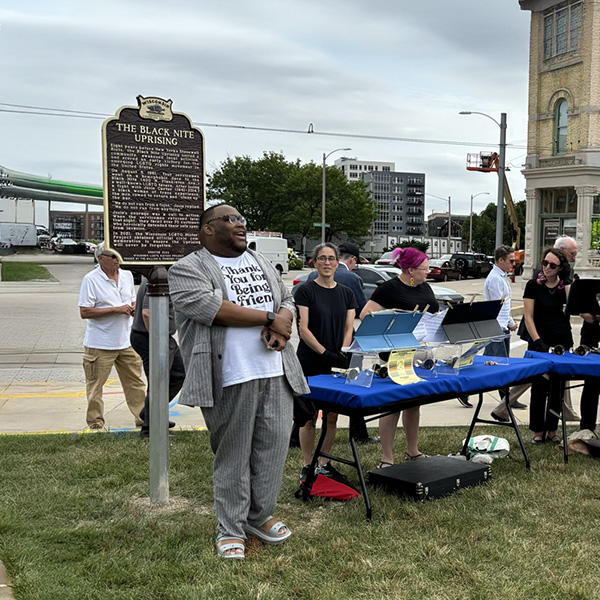
Tips For Writing Your Historical Marker
Tips For Writing Your Historical Marker
A marker inscription is the text that will appear on your historical marker. The length of your inscription will be determined by the size of the marker you choose for the site.
Document Your Research About the Marker Topic
While writing the text, we encourage you to document your facts and dates with footnotes. You will be required to develop an annotated bibliography and attach photocopies of your primary and secondary research resources with your application.
Use a Clear, Concise Writing Style
Write your inscription in a clear, concise narrative style. The third-person narrator is an objective observer who describes characters and their actions, thoughts, feelings, and motivations without direct knowledge. Focus on a single coherent story and describe the sequence of events in chronological order.
Is Your Marker for a Person in History?
We encourage you to include the person's birth and death dates, a chronology of the important events from the person's life, and the person's influence or significant contribution to the national, state, or local community.
Is Your Marker for an Event in History?
We encourage you to include the time, date, and place of the event, any people or groups associated with event, information on how the event developed, and the event's influence or significant contribution to the national, state, or local community.
Consider Adding an Image to Your Marker
For only a few hundred dollars more, you can include a photograph, map, or graphic on your Wisconsin State Historical Marker. Adding an image to your marker can greatly increase its visual interest. Including an image will reduce the total amount of text you can have on your final marker, but that trade-off might be worthwhile since, as they say, a picture is worth a thousand words. Contact the Historical Markers Program for sample images.
Things to Avoid
- Avoid words like "first," "oldest," "unique," or "only" unless there is irrefutable documentation.
- You must not list the name of any living person in the narrative.
Note: Text that is not clearly written or well documented will not be approved by the Society. The Society has the authority to make any editorial changes it considers appropriate or necessary. The Society reserves the right to reject a marker application that it deems offensive, either to general good taste or to a specific group of people.
FAQs About Applying for Historical Markers
Find answers to common questions about the Wisconsin State Historical Markers application process.
Markers are available in a variety of sizes, fonts, and prices. The cost of a Wisconsin State Historical Marker ranges between $870-$7,195. There is also a $250 application fee. The applicant must be able to pay for the cost of the marker and application fee, agree to maintain the marker in perpetuity, and have the permission of the landowner where the marker is to be erected.
Current Pricing Information for Historic Markers.
For only a few hundred dollars more, you can include a photograph, map, or graphic on your Wisconsin State Historical Marker. Adding an image to your marker can greatly increase its visual interest. Including an image will reduce the total amount of text you can have on your final marker, but that trade-off might be worthwhile since, as they say, a picture is worth a thousand words.
Anybody can apply for a marker as long as the topic addresses an aspect of Wisconsin's history. An application form must be completed for every historical marker desired.
The marker text requires the approval of several different Wisconsin Historical Society staff members. Please allow up to six months for us to review your application. After approval, the Society will order the marker from the foundry.
As of February 2026, the production time is estimated to be seven months from the time your order is received to when the marker is cast and shipped to you. It is highly recommended that you do not set a date for a dedication ceremony until you receive your state historical marker.
Wisconsin Historical Society staff review the text for the marker prepared by the applicant. Usually the first draft needs to be modified and is returned to the applicant with suggestions. Be sure to allow time for approval, especially if you are planning a marker dedication ceremony for a specific date. Once you and the Wisconsin Historical Society agree on the final version of the text, Society staff will place the order for the marker.
Markers should describe one of the following aspects of Wisconsin's history: archaeology, architecture, culture, ethnic associations, geology, history, legends, or natural history. Your topic needs to meet one of the Criteria for a Historical Marker Topic and Location. You can also review the Official List of Wisconsin Historical Markers to see what types of markers have been approved in the past.
No. You must order a plaque for the registered historic property directly from a vendor. Note: these plaques no longer require approval from the Wisconsin Historical Society. Several suppliers are listed below. This list is not a recommendation as other suppliers may exist.
- Atlas Signs and Plaques
- CenTec Cast Metal Products
- Colonial Brass Company
- Eagle Sign and Design, Inc.
- Erie Landmark Company
- Healy Plaques
- Sewah Studios
- American Sign-Letters
The William G. Pomeroy Foundation does provide a grant to fund the purchase of a National Register Plaque. Grants are available to 501(c)(3) organizations, nonprofit academic institutions, and local, state, and federal government entities within the United States. At this time, funding is not available for private residences or commercial properties. Interested individuals are encouraged to contact an eligible local organization, such as a municipal historian or historical organization. They will often apply for the grant on behalf of the individual.
To see if a property is listed on the registers, conduct a property record search through our State Historic Preservation Office.
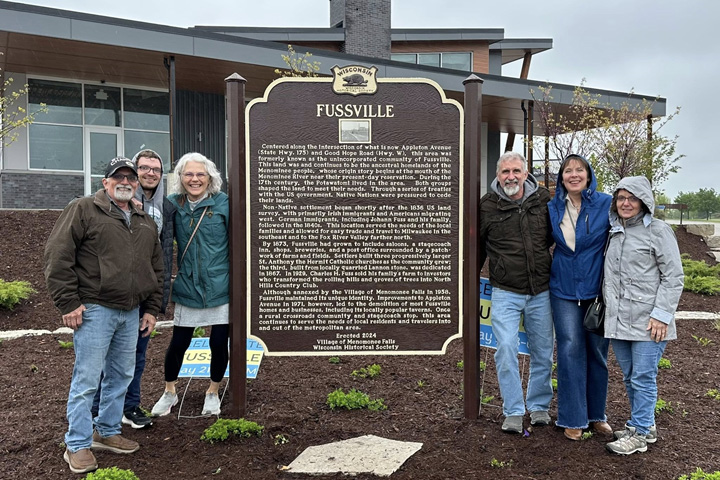
More About Wisconsin State Historical Markers
Read about the history of Wisconsin's state historical markers and find more information about the application process.
Explore MarkersQuestions about State Historical Markers?
We're here to help you get the information you need. Call the State Historical Markers Program at 608-890-3170 or use the email below.
Email Us