December 15, 2025
Local Champions
Columns Editor
Inspired by its support of local historical societies, Menomonie couple includes the Foundation in their estate plan
Roy Ostenso remembers a childhood trip to New York with his father. “He had to go to a meeting, so he dropped me off at a museum and said, ‘I’ll pick you up later.’ It was just fun. Maybe that’s how it all started.” Fast forward to Ostenso and his wife Celene Frey’s decades-long involvement in museums, local historical society boards and Frey’s recent recognition as Menomonie Chamber of Commerce Distinguished Citizen of the Year. Frey and Ostenso have been locally involved on every scale. As Ostenso says, “All stories of Wisconsin originate in a place and time. Every story in state history is a piece of local history.” The reverse is also true as Frey points out: “This little place had an impact on the whole state or the whole country or the world—like Menomonie, said to be once the largest lumber producer in the world.”
Just as a small town can have an impact on the country or the world, one person can also make a profound difference in their community, and beyond. Ostenso and Frey’s involvement in supporting Dunn County began in 1996 when Ostenso joined the Dunn County Historical Society (DCHS) board. From 2017-2023, Frey served as a board member with the Community Foundation of Dunn County (CFDC). During the organization’s 25-year anniversary in 2020, Ostenso and Frey were Visionary Sponsors and created an endowment fund to support the operations of the CFDC.
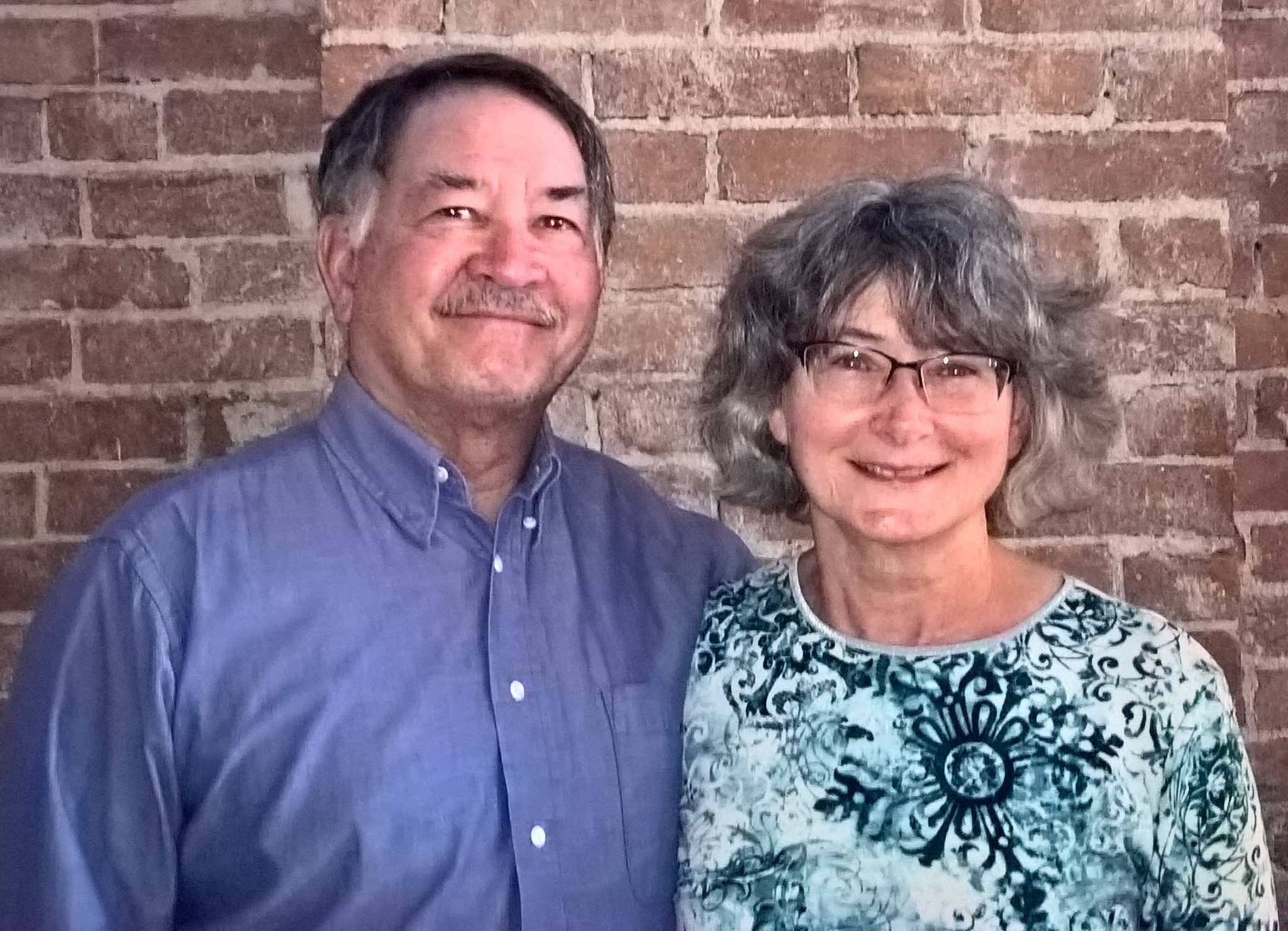
Roy Ostenso and Celene Frey
Frey then made her signature addition to their annual Jeans & Jewels fundraiser by establishing the gala’s Dessert Dash silent auction—a boisterous event that finds guests rushing from their seats to stake their claim on a donated dessert. Thanks to Frey’s leadership, the event exceeded that first year’s $3,000 goal. The following years, Dessert Dash subsequently raised $6,000, $11,000 and $16,000.
Outside of Frey’s involvement in CFDC, she held a fulfilling 33-year career with the University of Wisconsin-Stout. She began as an Admissions Counselor for 10 years, followed by 10 years in leading a peer advising program for new freshmen and advising undecided students, before concluding her work with the university as a professional advisor to new freshmen and undecided students. Now that she has been retired for 11 years, Frey says that advising was her first and primary passion—an impact that was surely felt by countless students.
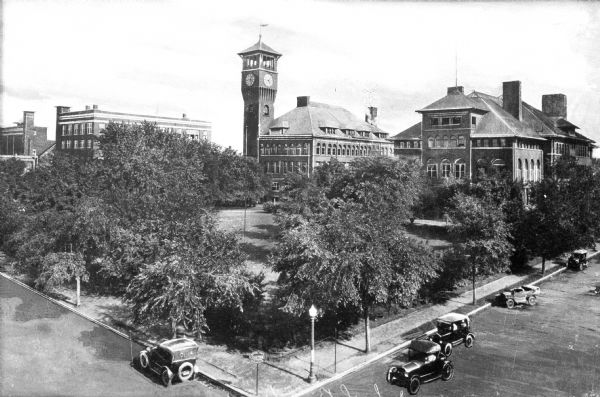
Elevated view of buildings on the Stout Institute campus (now the University of Wisconsin-Stout)
Ostenso’s professional and philanthropic career also left a mark on the organizations and individuals of Dunn County and beyond. In 1996, diving right into the work of the DCHS board, Ostenso played a major role in the two-year construction of the Russell J. Rassbach Heritage Museum—from helping to physically move items to putting up interior walls. In 2006 Ostenso helped secure $1.9 million for the adjoining Fulton’s Workshop addition.
As his curiosity in local history developed, Ostenso started attending the Local History and Historic Preservation Conference. This immersion in the world of local history taught Ostenso about fundraising, exhibit design and the storytelling of local history. He became involved the Wisconsin Council for Local History, an association of over 440 local, county, and specialized history and cultural organizations affiliated with the Wisconsin Historical Society.
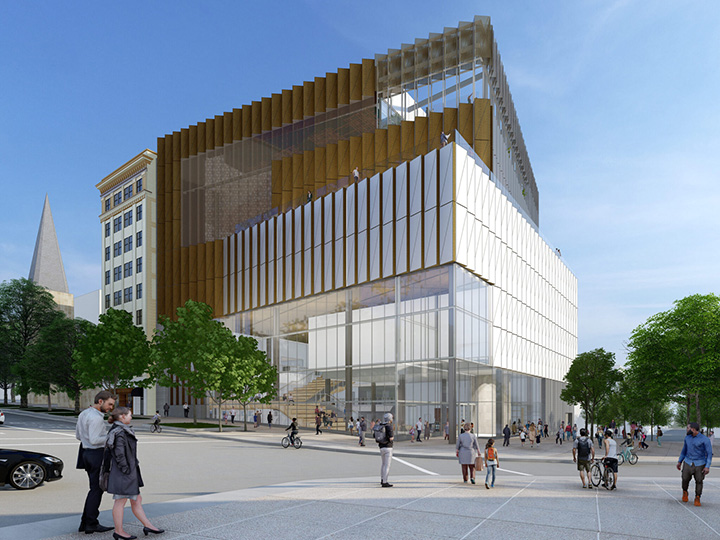
Ostenso’s passion for the Council’s mission to promote communication and cooperation among local history and cultural groups saw him elected to the Wisconsin Council for Local History board in 2010. He was elected to a two-year term as president in 2015 and, in turn, served on the Wisconsin Historical Society’s Board of Curators. By attending regional meetings offering educational programming, discussions and tours of the host organization’s’ museum, sites or historical features, Ostenso came to understand what makes a successful local museum. He recalls attending the American Alliance of Museums conference in Indianapolis in 2006 where he toured the then newly opened Indiana State Historical Society. Impressed with their facilities and exhibits, he thought of the possibilities of the future Wisconsin History Center. “I’ve been waiting for that to all happen, and I’m pretty excited now that it’s all coming to fruition.”
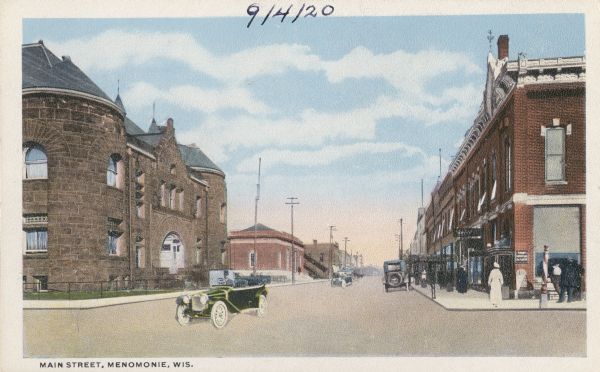
View down Main Street. Caption reads "Main Street, Menomonie, Wis."
Years later as the Wisconsin History Center moves closer to its completion in 2027, Ostenso and Frey reflect on the power of local history. Ostenso says, “Local history ends up being history of the state, the history of the country and sometimes the history of the world. It has to start somewhere.” Frey thinks back to their discoveries of local history on their travels: “What I find fun about local museums is that you can find one in a little town. I like to learn curiosities of a little town.”
Yet the task of the sharing the curiosities—and truths—of both big and small towns is no small feat. Ostenso remembers the words of “Don Quixote,” “The historian must write about them not as they should have been, but as they were, without adding or subtracting anything from the truth.”
He continues in his own words, “It’s a big responsibility to be a historian, to see things as they are and record things as they are.” Frey concludes, “as an observer the way they happened.”

This pictorial map of Dunn County, Wisconsin from the 1970s depicts historical events that occurred in the country.
The Society’s commitment to honor the responsibilities of historians led Frey and Ostenso to become members of the Robert B.L. Murphy Legacy Circle by including the Foundation in their estate plan. “We appreciate the support local societies receive from the Wisconsin Historical Society and want to leave a legacy gift to support this important work. When we became involved in our local historical society, we realized how local history is an important part of state history.”
Whether it’s gaining insights from the Local History and Historic Preservation Conference or exploring the Society’s vast collections, Frey and Ostenso find value in many aspects of the Society’s work. As Frey says, “Wisconsin as a state is important to all the parts that make it a state.” And in turn, all parts of the state and their histories are what shape the Wisconsin story. We’re so grateful for local history champions like Frey and Ostenso whoa are helping to preserve and share the story.
Last Updated: March 12, 2026