March 1, 2026
Oleo Wars
Director of Collections Information and Management
Jelke Good Luck Oleomargarine Shipping Crate
Object ID 2012.223.1
This wooden crate was manufactured for and used by Chicago, Illinois oleomargarine manufacturer John F. Jelke Co. of Chicago, to ship oleomargarine. Its rather ordinary appearance hides that it was once a weapon used in the “oleo wars”.
No Wisconsinite should be surprised to learn that residents of the state once had to “bootleg” their margarine from bordering states. And bootleggers could face a hefty fine. From 1881 to1967, the “oleo wars” raged in the dairy state with farmers pushing to protect butter from the fraud of imitation spreads known as oleomargarine (also known as oleo or margarine).
Interior view of a butcher shop, with a male butcher sharpening a knife behind a counter lined with cuts of meat, sausages and a scale. Behind the counter on a wood cabinet is a sign reading "Oleomargarine Sold Here" and a 1911 oleo tax stamp. ID:W013ZX3
Oleomargarine Lands in the United States
Invented in 1867 in France by combining beef fat with milk and water, oleomargarine landed in the United States in early 1870’s. The first oleomargarines were inexpensive to make, did not require refrigeration, and spread like butter. Although white in color, with a little yellow dye oleomargarine could easily be mistaken for butter. By 1880, fifteen oleomargarine factories operated in the United States with the Chicago based Armour and Company joining the crowd in 1883. At a time of economic struggle following the Panic of 1873, margarine swept across the country.
The development of a butter imposter made dairy farmers nervous. In the 1870s, Wisconsin dairying had just begun the process of industrializing the production of butter and cheese. The Wisconsin Dairymen’s Association formed in 1872 as a way for dairy farmers to modernize production, collectively advocate, and ensure quality. As the popularity of margarine grew, farmers mounted a full-on attack of their artificial competitor in the form of lobbying for government intervention.
States created the first oleo regulations in 1881, including Wisconsin. In 1886, the federal government passed the Oleomargarine Act of 1886 which imposed a two-cent per pound federal tax; created permits for manufacturers, wholesalers, and retailers; and required distinctive ten-pound wooden tubs for shipping. But Wisconsin dairy farmers pushed for more regulations on both the state and federal level. In 1895, Wisconsin barred the manufacture and sale of yellow margarine while also imposing a tax on white oleomargarine. The federal government passed the Grout Bill strengthening federal regulations on oleomargarine in 1902.
John F. Jelke Company
F. Jelke & Son was one of the first companies in the United States to sell oleomargarine and in 1889, John F. Jelke began manufacturing the product. Based out of Chicago, the John F. Jelke Company branded their oleomargarine as Good Luck Margarine and heavily marketed it. A stalwart oleomargarine advocate, Jelke worked tirelessly to grow the sale of his product.
The John F. Jelke Company was one of the first to introduce a yellow dye that could be added by the customer after they had purchased white margarine as a way to thwart regulations and higher taxes on yellow margarine. Jelke was so eager to see consumers get yellow margarine that he teamed up with bootleggers to avoid the higher taxes. And in 1911, a federal grand jury indicted him for conspiracy to evade taxes. Jelke, despite being found guilty and sentenced to two years in prison and a $10,000 fine, never served a day in prison. He was pardoned by Woodrow Wilson after a near decade long legal battle. Jelke and his heirs continued the fight for margarine (particularly yellow margarine) until 1948 when the company was sold to Lever Brothers.
Wisconsin was the last state to repeal the ban on yellow margarine in 1967. The repeal did, however, include a tax of five and a quarter center on every pound. This tax expired in 1973 and today yellow margarine is a ubiquitous grocery store product.
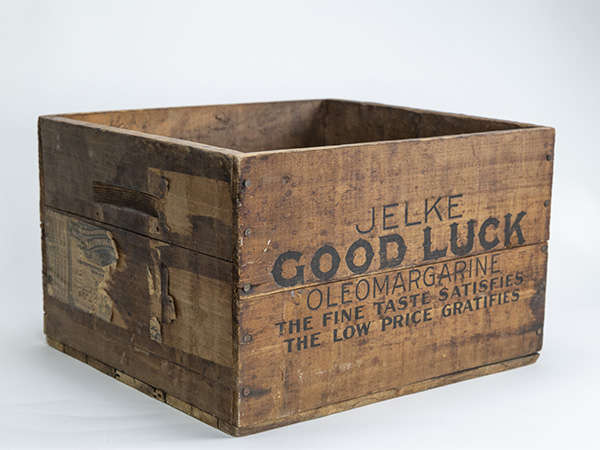
Jelke Good Luck Margarine shipping crate with a tax stamp on the side.
Reprint from the pages of "Hoard's Dairyman" magazine issued to influence public opinion in Wisconsin where the sale of colored margarine was prohibited by law. ID:W012FY2
The Many Shades of Butter (and Margarine)
In 2026 most butter is lighter in color. Why? Most dairy cows in the United States are Holsteins. They produce lighter colored butter fat and don’t graze in a pasture. Fresh grass provides cows the beta-carotene that gives butter its color. The natural color of butter varies greatly based on the diet of the cows.
Before the shift to factory produced dairy products in Wisconsin, the quality of butter varied greatly. Prior to the 1870s most farmers in the state produced some butter on a small scale. Dairy products like butter and cheese were often viewed as a source of cash generated from the "extra" milk on the farm and went bad without expensive refrigeration.
The name oleomargarine came from combining the Latin word for beef fat, oleum with the Greek work for pearl, margarites. Margarine's original formula created a white substance whose appearance did not resemble butter. The color of margarine has also changed over the years as manufacturers shifted from using beef fat to plant oils. Some plant oils naturally provide an amber hue for margarine. Most margarine today is dyed during production to more closely resemble butter.
Sources
-
Suval, John. "(Not) Like Butter," Wisconsin Magazine of History. Autumn 2012.
-
Stery, Gerry. "The Oleo Wars," Wisconsin Magazine of History. Autumn 2001.
-
"The Freedom to Buy," Janesville Daily Gazette. (Janesville, WI), January 16, 1967.
-
"Oleo to mark First State Anniversary," Leader-Telegram. (Eau Claire, WI), July 30, 1968.
-
"Lever Bros. Enter the Oleomargarine Field," Waukesha Daily Freeman. (Waukesha, WI), June 25, 1948.
-
"Nine Convicted of Oleo Frauds," The Stoughton Courier. (Stoughton, WI), March 19, 1914.
-
"Jelke Dodges Cell in Federal Prison," The Journal Times. (Racine, WI), March 5, 1920.
-
"Since Milk is White, Why is Butter Yellow?" New York Times. October 14, 2016.
Last Updated: August 12, 2026