McCormick-International Harvester Collection


Dive Into McCormick-
International Harvester
An archival treasure trove with two hundred years of American history, this collection has McCormick family papers as well as the corporate archives for International Harvester.
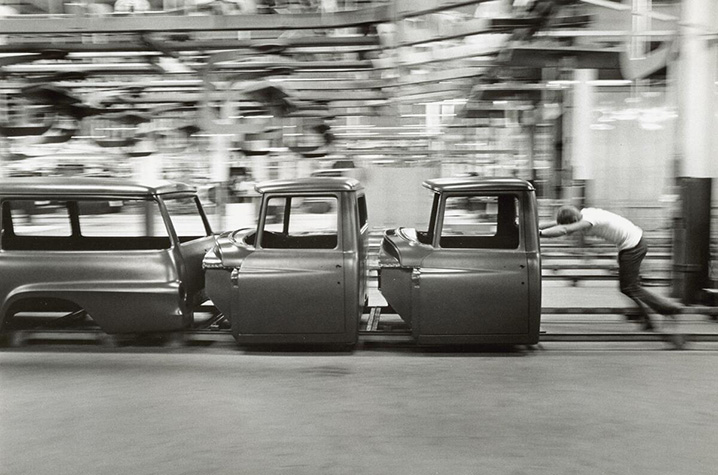
Line Set Tickets
Lineset Tickets (LSTs), also known as Line Setting Tickets or Build Sheets, are like the birth certificate for a machine. IH created these records for every division, but our collection here only has LSTs for trucks manufactured 1955-1985.
Copies can be purchased for a fee and the current wait time is about 6 months. Orders can be placed by sending us an email with the VIN, MODEL and YEAR typed into the body of the message. No fees are collected until the order is filled. We appreciate your patience with the long wait time. More details will be included with the autoresponder message after you send in your request via the Contact Us button below.
About The McCormick-International Harvester Collection
The McCormick-International Harvester Collection contains over 12 million archival documents, maps, photographs, posters, letters, films, books and magazines dating from 1765 to the 21st Century. Even though we talk about it as one collection, it’s arranged into multiple archival collections. The earliest records are from inventor Cyrus McCormick and his descendants. There are McCormick family papers and household accounts as well as business records from the farm equipment company Cyrus founded in 1847. In 1902, that company merged with several others (including their main business rival, Deering) to become International Harvester. The corporate archives for IH are also part of the McCormick-IH Collection. Topics covered include the history of the mechanization of agriculture but also the history of advertising, labor, architecture, rural life, Chicago, and motor trucks.
International Harvester Decorator Refrigerator advertisement featured in the Saturday Evening Post, Better Homes and Gardens, and Ladies' Home Journal magazines. The advertisement highlights the Decorator Refrigerator as well as IH's marketing campaign of aesthetically pleasing home refrigerators. ID:W0145QZ
Features of The Collection

Truck Specifications
International Truck Specifications (1907-1983) are arranged by model type, then by year. Spec sheets include data like gross weight and also a visual. The link below will take you to the complete list for every model we have. Add your model to the search box at the top if you don’t want to scroll the long list.
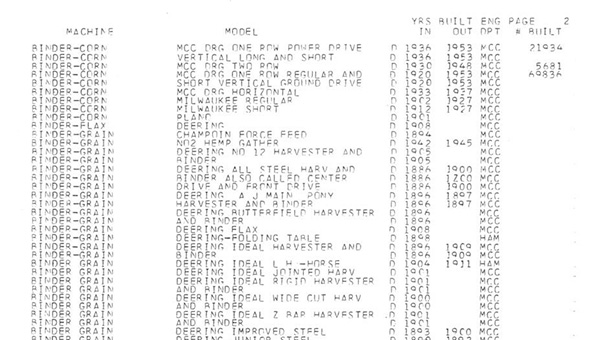
Machine Product List
International Harvester’s Machine Product List is a document produced in 1980 and it’s the most complete accounting of what the company produced up to that point.
Arranged by type of machine (check the index in front), it has factory, year of first build, year of last build and total production number.

Operator and Service Manuals
Copies of manuals in the collection can be purchased for a fee. The index of titles is not available for public searching, but if you send us an email with the model and year we can search on your behalf. Wait times are about 6 months. The collection is more complete for the years between 1900 and 1970, and does not have any Ag Division manuals after 1985.


Search the Society's library and archival collections in the University of Wisconsin-Madison's library catalog.
Search our archival finding aids which describe some of the archival resources held by 19 repositories throughout Wisconsin.
FAQs
We do not. The only LSTs we have are from the Motor Truck Division. IH sold their Ag Division to Tenneco In the mid-1980s, and the build sheets stayed with the factories that were sold. Tenneco created a new brand called Case-IH (now CNH). Those records were donated to the Racine Heritage Museum, and you can visit their website at this link.
We do not. The brands Case and IH did not become “CaseIH” until the 1980s when IH sold their Ag Division to Tenneco. The Society does not house the Case Archives, those are at the Racine Heritage Museum, and you can visit their website at this link.
These companies source their tickets from the Society and then re-sell them to customers.
Unfortunately, there is no rush option for these copy orders.
History of the McCormick-IHC Collection
After the 1884 death Cyrus Hall McCormick, the industrialist, inventor, and founder of the McCormick Companies, his widow Nettie and their children hired secretaries to collect his manuscripts and memorabilia.
In 1912, they formed the McCormick Historical Association to preserve McCormick's work and accomplishments, which had laid the foundation for the development of the modern agricultural implement industry worldwide.
McCormick Historical Association, Chicago
1915-1949
In 1915 the McCormick family hired historian Herbert Kellar to manage the McCormick Collection and to head the McCormick Historical Association in the McCormick mansion in Chicago. A few years later, the association moved out of its headquarters in the McCormick mansion at 675 Rush Street in Chicago and into a large stone carriage house at the rear of the property. The carriage house was remodeled to include a library, museum, offices, and facilities for research. For the next 30 years Kellar collected papers, photographs, and artifacts. The collection grew from 10,000 to more than 1 million items. It included the papers of Cyrus Hall McCormick, records of various McCormick companies in Chicago prior to 1902, plus a number of collections relating to agriculture and to Cyrus Hall McCormick's native state of Virginia. In 1949 the land and buildings of the McCormick Historical Association were sold in an estate settlement, and the collection was placed in storage.
Society Becomes Permanent Home for the McCormick Collection
1951
Cyrus' daughter, Anita McCormick Blaine, assigned Herbert Kellar the task of finding a permanent home for the McCormick collection. At the time, the collection was considered one of the most important collections of manuscripts in private hands, and was highly coveted. Between 1949 and 1951, Kellar traveled more than 15,000 miles investigating 30 institutions. One of the institutions visited was the Wisconsin Historical Society. Clifford Lord, the Society's director at the time, lobbied vigorously for the collection. He argued that the Society would make an ideal home for it. The Society was located in the Midwest and close to the McCormick's Chicago home. In addition, the Society had been around for more than 100 years, had the necessary storage and research facilities, and a national reputation for its outstanding collections. Finally, it was affiliated with the University of Wisconsin, which had a world-class history department and agricultural school. Kellar ultimately agreed. The fact that he had attended school at the University of Wisconsin, and that his wife was a Wisconsin native, may have also played a role in his decision. In 1951, based on Kellar's recommendation, Blaine donated the McCormick Collection to the Society.
The McCormick Collection Grows
1952-1959
The Society hired Kellar and his wife Lucile to continue to manage the collection. Kellar died in 1955, but Lucile continued as the McCormick curator well into the 1960s. In the meantime, the McCormick family continued to donate additional material. By the time Lucile Kellar retired in 1967, the collection had grown to include the business and personal papers of family members Nettie Fowler McCormick, Mary Virginia McCormick, Stanley McCormick, Harold McCormick, Anita McCormick Blaine, and Cyrus McCormick Jr.
International Harvester Donates Materials
1959-1985
The International Harvester Company, long affiliated with the McCormick Companies, also made large donations of materials to the Society. In 1959, the company shipped several truckloads of farm implements and models to Stonefield, the Society's farm and craft museum in Cassville. In addition, when the old McCormick Works in Chicago closed, the company donated 19 tons of financial ledgers dating back to the first McCormick companies.
Indexes and Guides Developed
1960s-1970s
After Lucile Kellar retired, a succession of archivists served as experts on the McCormick Collection. Much work was done to preserve the collection and make it more accessible to the public. In addition to creating numerous indexes and descriptive lists, the Society published an extensive "Guide to the McCormick Collection" and completed a grant-funded project to preserve and describe more than 12,000 glass-plate negatives of the International Harvester Company. During this period, the papers of Fowler McCormick and the records of the McCormick Estates were added to the collection.
Navistar International Transportation Corporation Donates Materials
1985-present
After selling off its agricultural equipment line to Case-IH, the company changed its name from International Harvester to Navistar International Transportation Corporation. In the late 1980s, Navistar contacted the Society about materials in its corporate archives. It wanted to donate a portion of its old International Harvester agricultural equipment records. The Society, already home to the McCormick Collection, was the natural destination for this material. After some negotiation, Navistar donated more than 1,000 cubic feet of advertising literature, operators' manuals, company publications, press releases, photographs, films, and other public relations and marketing materials. The collection was then renamed McCormick-International Harvester. Also, great-grandson Brooks McCormick made a substantial gift of money to the Society to help preserve and manage the collection.
The McCormick-International Harvester Collection Today
present
Today the McCormick-International Harvester Collection consists of more than 12 million manuscript pages, 350,000 photographs, and 300 films. In addition, the Society's museum, library, and historic sites hold thousands of books, agricultural newspapers, machines, models, toys, and pieces of clothing that were donated by the McCormick family and International Harvester.
Collections Use FAQs
Explore how you can find, access, and use our collection materials.
The Society's library and archives collections can be searched in the University of Wisconsin-Madison Library catalog and some parts of our collections have been digitized and are available online.
The Society's historical object collection cannot be searched online.
Library & Archives
Many books, bound periodicals, microforms and government publications may be checked out for home use with a library card. Rare, fragile, small and heavily used materials (including genealogical resources) do not circulate. A borrowing card is not required if you want to use materials within the Library. Archival materials are available for use in our Archives Reading Room.
For more information about our borrowing policies Library & Archives Services.
Historic Objects
If you are interested in viewing our historical objects please contact us.
Due to significant demands associated with developing the Wisconsin History Center, the Society has reduced capacity to handle loan requests. Therefore, we are not accepting new requests at this time.
For a credit line: Wisconsin Historical Society, Creator, Title, Unique Identifier.
The Unique Identifier can be found at the top or bottom of the webpage for each item. The name of a downloaded file is NOT the unique identifier.
For bibliographic citations please consult the UW-Madison Libraries Citation Research Guide to ensure compliance with appropriate style guidelines.
-
Personal use (prints, gifts, home and study): Request images for personal use
-
Commercial use (public display, publishing, media, products, film and more): Request commercial use of our Collection
Materials in our websites and digital collection are provided for research, teaching, and private study. The Wisconsin Historical Society hold rights to some items; others may be governed by additional copyright or donor restrictions.
We encourage users to download low-res images from our website for personal or classroom use, without written permission, within the meaning of the principles of “Fair Use.”
Permission is required for reproduction, publication, or commercial use of any content made available through our websites and digital collection. By using this website, including our digital collections, you agree to the Terms of Use. Users are responsible for determining whether their intended use qualifies as fair use under U.S. copyright law. When relying on fair use, cite the source.
Have Questions?
Reach out about the McCormick-International Harvester Collection!
Archives: 608-264-6460
Email Us
Visit Our
Library & Archives
Perhaps the best way to begin exploring our collections is by visiting us in person. In our reading rooms, you’ll find free and unparalleled access to our collections, helpful staff and amenities, and perhaps, your very own story.
Plan Your Visit Hours
Donate to The Society's Collections
Your Story is Wisconsin's Story
History is made every day, everywhere. Since 1846, contributions from people across the state have helped us fulfill our mission to collect, preserve and tell the stories of Wisconsin.
Find Out How