Wisconsin Historical Society Web Archives
Take A Closer Look!
To supplement our collections, the Society collects and preserves selected websites from state agencies and local governments, political campaigns for gubernatorial or U.S. Senate races and related social media, and sites for important issues in Wisconsin such as mining and organic agriculture.

Wisconsin Historical Society Web Archives
Websites for Wisconsin State Agencies, Local Governments, Wisconsin Politics and More
This effort aims to provide permanent access to websites and other digital materials for researchers and the general public. By harvesting the content of these websites through the "Archive-It" subscription service, the Wisconsin Historical Society collects, preserves, and makes accessible these electronic publications and records for public use.
While the Society continues to collect materials on paper, many of the records and publications it collects are no longer printed; instead, these documents originate as digital files and are often published on the websites of state agencies or counties.
The Society has used the Internet Archive's Archive It tool to collect and preserve select websites since 2010 and has collected over 800 individual websites.
View All Wisconsin Historical Society Archive-It CollectionsFeatures of the Collection
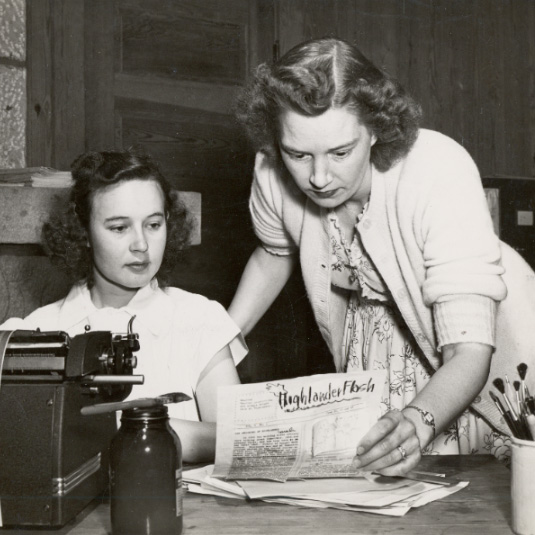
- Websites related to selected manuscript collections held by the Collections Division, including the Highlander Research and Education Center and the United States Pharmacopeial Convention.
- Newsletters on topics including (but not limited to) agriculture, military affairs, politics, labor, religion, genealogy, local history, and Native American news.
- Websites documenting Wisconsin's response to the Covid-19 Pandemic and journals kept by Wisconsin citizens.
CIO school in the 1940s. Features two women reviewing the "Highlander Flash," a newsletter produced by the Highlander Folk School. ID:W012PK0
Government Websites
- Archived version of websites for Wisconsin state government agencies, boards, commissions, and projects
- Archived web sites of Wisconsin cities and towns
- Archived web sites of Wisconsin county government agencies and regional planning commissions (RPC)
Political Campaigns
Archived websites for political campaigns in Wisconsin, 2010-2024.
Frequently Asked Questions
The Wayback Machine allows users to browse billions of pages of archived websites. The primary difference between the general Wayback Machine web portal and Archive-It websites collected by institutions such as the Society (which are also viewed through the Wayback portal) is that Archive-It collections are full-text searchable. Society staff selects websites to preserve in various collections and can capture websites at strategic times, while the general Wayback Machine may or may not have an archived version of the website for which a user is searching.
Several factors affect how often we crawl a website, such as how often the site is updated with new content, whether the site is used to communicate news, how long content remains on the site, the relationship of items on the website to holdings in the paper collections, and news events that affect the content of a site. Publications and some websites, such as state agencies and county government, are crawled on a scheduled frequency, while others are captured on an as-needed basis. Other times we try to capture a website before it is discontinued or redesigned.
Enter a search term in the box on this website to browse across all archived Society websites or browse by collection either from the Society Archive-It collection overview page or links to individual collections. Click on the URL for a website to see a calendar page with linked dates for all captures. An archived web page will display a yellow banner across the top with the capture date, the collection name, and the collecting institution.
When a website changes its address, the old URL will usually redirect to the new URL, at least for a short period of time, if not longer. However, in order to be clear about the address of the website we harvested, we create another listing when a website changes its URL. Because of the redirect function, the later crawl dates may continue to display for the seed of the older URL. See the Description field for the related URLs.
Usually, this is due to a slight variation on the URL: e.g., www. in front of a URL or without it, or the presence or absence of an ending slash. There may be slight differences between two captures with the same date.
Some archived videos may not play back on the page, however, users can still access the videos using the Videos link. At the banner at the top of the page (“You are viewing an archived web page ….”), click on the link (“Videos”) to access this content (click “Watch”).
As we review harvested websites to make sure that we captured the content we intended to archive, we are able to view missing URLs and run crawls to capture missed content. Consequently, the date on the Archive-It banner may reflect the date of this secondary capture. Alternatively, some linked sites would normally be out of scope for a particular site, but because those sites are also being harvested for the collection, may default to an earlier capture of that site, hence the earlier date. Or linked sites that would usually be out of scope for a particular site may have been separately crawled for the collection and may default to an earlier capture of that site.
It’s possible the content may not have been captured (in these instances, a “Not in Archive” screen will usually appear), but if you experience consistent difficulty viewing archived websites one troubleshooting approach is to try using another browser (for example, Firefox or Chrome).
Please note that some types of web content such as database driven content (or anything that requires user input) is not accessible on captured websites, nor are some functions enabled by some scripting languages such as JavaScript. Similarly, links to pages external to the main site will be considered out of scope and will not be archived.
Please include the Wayback URL, the date of capture, and the following credit: “Courtesy of the Wisconsin Historical Society Web Archives”.
As with other records held by the Society's library and archives, the Society often does not hold the copyright for those materials. The responsibility for determining copyright and obtaining the appropriate permissions for use rests with the user, not the Society.
An asterisk indicates that the page was updated with new content. Capture dates without an asterisk indicate that the website has not changed since the previous capture. The banner in these instances may read, “Note that this document was downloaded, and not saved because it was a duplicate of a previously captured version.”
Generally, Archive-It does not archive the same data a second time if it has already captured that data. This feature helps conserve our data budget.
Collections Use FAQs
Explore how you can find, access, and use our collection materials.
The Society's library and archives collections can be searched in the University of Wisconsin-Madison Library catalog and some parts of our collections have been digitized and are available online.
The Society's historical object collection cannot be searched online.
Library & Archives
Many books, bound periodicals, microforms and government publications may be checked out for home use with a library card. Rare, fragile, small and heavily used materials (including genealogical resources) do not circulate. A borrowing card is not required if you want to use materials within the Library. Archival materials are available for use in our Archives Reading Room.
For more information about our borrowing policies Library & Archives Services.
Historic Objects
If you are interested in viewing our historical objects please contact us.
Due to significant demands associated with developing the Wisconsin History Center, the Society has reduced capacity to handle loan requests. Therefore, we are not accepting new requests at this time.
For a credit line: Wisconsin Historical Society, Creator, Title, Unique Identifier.
The Unique Identifier can be found at the top or bottom of the webpage for each item. The name of a downloaded file is NOT the unique identifier.
For bibliographic citations please consult the UW-Madison Libraries Citation Research Guide to ensure compliance with appropriate style guidelines.
Personal use (prints, gifts, home and study): Request images for personal use
Commercial use (public display, publishing, media, products, film and more): Request commercial use of our Collection
Materials in our websites and digital collection are provided for research, teaching, and private study. The Wisconsin Historical Society hold rights to some items; others may be governed by additional copyright or donor restrictions.
We encourage users to download low-res images from our website for personal or classroom use, without written permission, within the meaning of the principles of “Fair Use.”
Permission is required for reproduction, publication, or commercial use of any content made available through our websites and digital collection. By using this website, including our digital collections, you agree to the Terms of Use. Users are responsible for determining whether their intended use qualifies as fair use under U.S. copyright law. When relying on fair use, cite the source.
Visit Our
Library & Archives
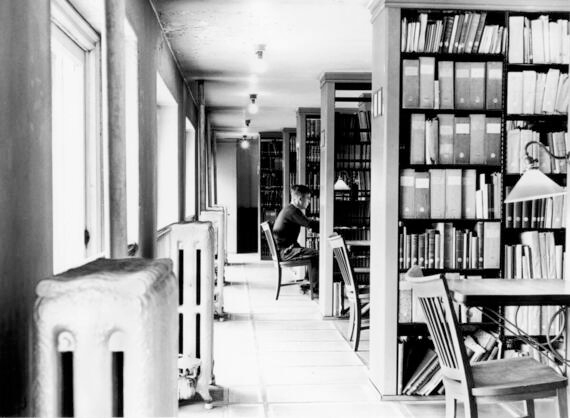
Perhaps the best way to begin exploring our collections is by visiting us in person. In our reading rooms, you’ll find free and unparalleled access to our collections, helpful staff and amenities, and perhaps, your very own story.
Plan Your Visit Hours
Donate to The Society's Collections
Your Story is Wisconsin's Story
History is made every day, everywhere. Since 1846, contributions from people across the state have helped us fulfill our mission to collect, preserve and tell the stories of Wisconsin.
Find Out HowLast Updated: April 27, 2026